Italea
descrizione immagine

Route length 2 days

Back to the roots in the footsteps of Nuovo cinema paradiso

descrizione immagine

The experience


Un viaggio nel cuore della Sicilia che permette ai viaggiatori delle radici di rivivere luoghi di memoria dell’emigrazione, di storia cinematografica, di arte e artigianato, di tradizione popolare ed enogastronomica.

Biscaquino e Palazzo Adriano – Un’imperdibile passeggiata tra i vicoli degli antichi borghi, tra i luoghi che hanno ispirato la celebre pellicola del regista Giuseppe Tornatore, vincitore del premio Oscar per il suo “Nuovo cinema Paradiso”, racconto struggente della Sicilia di un tempo e atto d’amore per la propria terra. Una proposta che vede coinvolti giovani promotori e comunità locali che vi consentiranno di conoscere le vostre radici passeggiando tra gli oggetti di scena del film e i cimeli del periodo delle riprese, dalla bicicletta su cui Alfredo portava in giro il piccolo Totò alle sedute del Cinema Paradiso: tesori custoditi nel nuovo Museo allestito all’ex Palazzo del Municipio, inaugurato nel 2022. Un itinerario irrinunciabile per turisti e appassionati di cinematografia.

Andare a Burgio vuol dire perdersi tra il suono delle campane dell’ultima fonderia, il profumo intenso delle ceramiche stagnate, i chiaroscuri dei portali in pietra. L’antica Scirtea sicana era nota da tempi antichissimi, come raccontano i ruderi del castello inaccessibile di Acristia, ma di Burgio si inizia a parlare sotto l’emiro arabo Hamud. Nel Trecento finì nelle mani dei Peralta, poi dei Gioeni, poi dei Colonna. 

Chiusa Sclafani è un borgo che è un merletto barocco tra conventi, set e atelier.
Un merletto di stucchi, chiese che paiono scrigni preziosi del tutto inattesi. Ma è anche un borgo che custodisce un tesoro prezioso e commovente della memoria dell’emigrazione: l’orfanotrofio femminile, all’interno del monastero della Badia, dove venivano accolte le figlie che le donne non potevano portare con sé prima di emigrare all’estero e che apre eccezionalmente le sue porte per i viaggiatori delle radici. Abiti in organza, cotone e lana, bambole cucite a mano, una giostra, un cavallino a dondolo, tanti pupazzi colorati. Le bimbe, private dagli affetti dei propri cari, venivano affidate alle cure delle suore, che le facevano studiare e impegnare in attività ludiche, in attesa del ritorno dei propri familiari nel periodo estivo quando tornavano per le ferie. Visitare Chiusa Sclafani oggi vuol dire scoprire un borgo autentico, un gioiello scelto anche dagli artisti, come il pittore e incisore palermitano Giovanni Schifani. Imperdibili sono il monastero dei padri Olivetani, anche questo tra i set di “Nuovo Cinema Paradiso”, e la bottega di Giuliano Colletti, alla riscoperta di un antico mestiere. Grazie a questa passione di famiglia, molti antichi organi, nella maggior parte dei casi di grande pregio, oggi possono essere restaurati e tornare a fare sentire la loro “voce”. 

Senza dimenticare il gusto: un’azienda d’eccellenza del borgo aprirà le porte per condividere con i visitatori una passione: la trasformazione del latte in formaggi e ricotta. Premiati all’Italian Cheese Awards 2022 di Bologna, i componenti di questa famiglia ogni mattina trasformano il latte del proprio allevamento di ovini. Salvatore e Rosario, addetti all’allevamento e alla mungitura del gregge, conferiscono giornalmente il latte fresco che viene lavorato da Marisa, Giusy e Giuseppe. Una degustazione conclusiva delle prelibatezze appena prodotte si rivelerà una scoperta sorprendente.

In a few words

Historic Villages
Memory
Archives
Traditions
Museums
Handicrafts
Tastings
Workshops
cinema

Tour

BISACQUIN


Bisacquino, the native land of the great film director, naturalized U.S. citizen, Frank Capra. The director of “A Wonderful Life. Here, together with the youth of the village, it will be possible to learn about the extraordinary history and the most striking corners of the village with a very special guided tour.

Our journey will start right from Frank Capra Street, where it all began before the director embarked on his journey to the United States. Along the way, you will see posters dedicated to his most famous films and even read his birth certificate. Frank Capra’s story is linked to the emigration of the many Sicilians who crossed the Ocean, seeking America.

The walk peaks at the belvedere, with a beautiful view of the surrounding area. Along the way, the most striking views of Bisacquino can be admired in an evocative series of photographs. The final stop is the Civic Museum, where unique documents and films chronicling Capra’s career can be viewed. The museum is considered one of the five most important ethno-anthropological museums in Sicily. Its establishment, dating back to the end of the last century, was made possible thanks to numerous donors from the village animated by a desire to pass on the traditions of Bisacquino. This is a fascinating display of ancient objects that allow us to retrace the ancestors’ way of life and the organization of their daily lives. Consisting of sixteen different areas, from archaeology to collections of weapons and musical instruments, from photography to agricultural implements, it allows people to take a journey back to their origins.

Address: Frank Capra Street, Bisacquino (Palermo)

Address : Municipal Museum, Olmi Street, Bisacquino (Palermo).

The tour will continue with a guided tour of the Mother Church dedicated to St. John the Baptist, considered one of the most beautiful in the diocese, a true treasure chest of art treasures, and Triona Square, which originated in Arab times.

The square, initially created without any precise architectural design, later acquired a well-defined physiognomy and division of space between the people, clergy and nobility. In the center of the square, a beautiful fountain has replaced the old drinking trough, but has retained the ancient masks representing the noble families of Bisacquino.

Address: Triona Square, Bisacquino (Palermo)

This will be followed by a typical lunch in a bisacquinese farmhouse to rediscover the flavors of the past: protagonists are the “onion busacchinara” and extra virgin olive oil.

ADRIAN PALACE

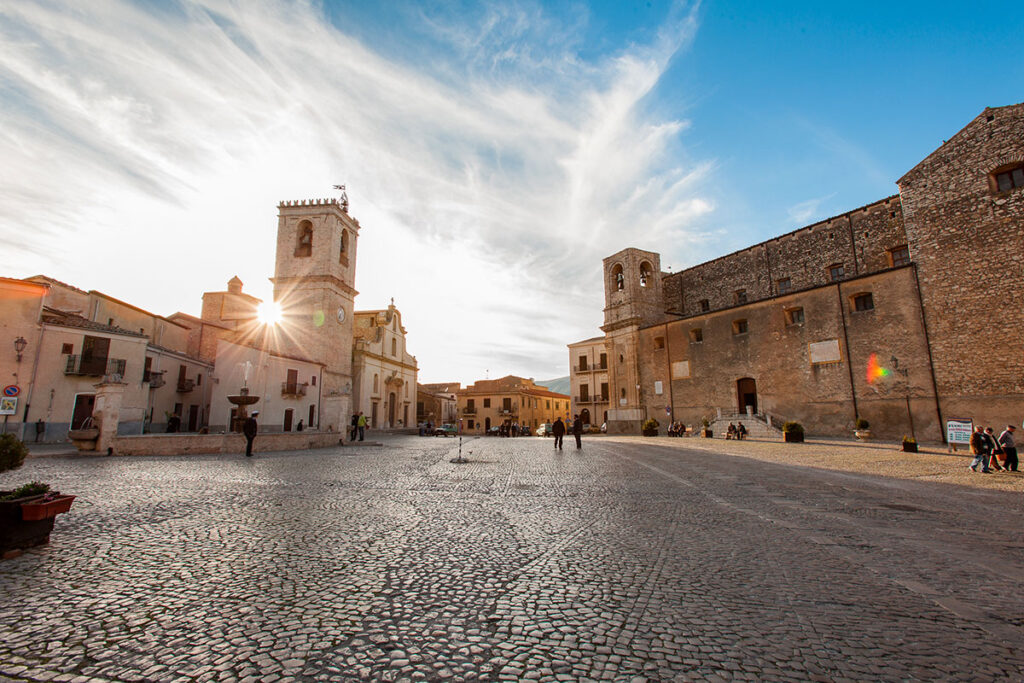
Transfer to the nearby town of Palazzo Adriano, the main set of Nuovo Cinema Paradiso, the Oscar-winning film by Giuseppe Tornatore.

This will be the site of a unique poignant storytelling that branches out in a radial pattern from the spectacular main square where the set of the projection booth where, in the film, Alfredo-Philippe Noiret works and where little Totò hides to steal the secrets of the trade was set up (and then dismantled at the end of filming). Instead, the interior of the cinema was rebuilt in the Church of Mary Most Holy of Carmel. A walk through the characteristic alleys of the Sicani village will be like feeling at home, among friendly faces and the scents of tradition.

Following this, the tour will include a cooking class, where we will go to. “hands on dough” in collaboration with a historic bakery in the village, a way to retrace with your hands the gestures of your ancestors. And it will not be “normal” bread that you will learn to make, but the votive bread of St. Joseph, an important feast in many Sicilian municipalities. Bread, that is, that is prepared on March 19 for altars set up in private homes, with the most varied shapes. A feast that celebrates, along with the saint, nature, wheat, and the coming spring.

What better opportunity to learn how to prepare it, and to learn about the shapes, decorations, and meaning. Among the fragrances of the bakery will be a beautiful journey into tradition. At the end of the experience, you can taste bread accompanied by typical products of the village.

Typical dinner. Overnight stay.

Address: 34 Cittadella Street, Palazzo Adriano (Palermo)

BURGIO


A guided walk will allow visitors to visit the capital of Sicilian ceramics, starting from the famous museum set up in the former convent of the Reformed Fathers to the last workshops where the secrets of this centuries-old craft will be told, crossing medieval streets that lead to the Castle of the Peralta nobles, perched on a rise above the town.

Surprising treasures will be recounted by young insiders in the village, including the Mother Church with its eleven altars, the 16th-century San Vito with its marble statue of the saint sculpted by Antonello Gagini, and the Baroque church of San Giuseppe, considered a small Sistine Chapel of Sicily. It closes with Paolo Pendola’s small nativity scene museum where it will be possible to make a ceramic artifact.

Light lunch of Burgio specialties.

Address: Burgio (Palermo)

LOCK SCLAFANI

In the afternoon, continuation of the tour with a transfer to Chiusa Sclafani, where you can visit the ancient monumental complex of La Badia, where the orphanage where women used to leave their little girls before emigrating abroad will exceptionally open its doors: a moving journey through memory, among cribs, letters, little dresses. And then the immense Monastery of the Olivetan Fathers, where Giuseppe Tornatore shot some scenes of Nuovo Cinema Paradiso.

Once the visit is over, it will be time to discover a living treasure: Giuliano Colletti, one of the few craftsmen in Sicily who is involved in the restoration of pipe organs, so much so that he is registered in the national register of “professional restorers of cultural heritage.” The craft of organ-building is multifaceted, as one must be a skilled carpenter, welder, and tuner to practice it.

Visitors will be able to appreciate the different stages of restoration, see up close what a pipe organ looks like and how it works. In short, discover their innermost secrets and also learn about the main stages of the construction of new organs.

An interesting journey with an old-fashioned flavor into a craft of yesteryear.

At the conclusion of the tour, a visit to a local family business that, following ancient traditions, produces a sheep’s ricotta cheese considered among the finest in Italy.

The visit to the dairy will allow the visitor to learn in detail about the stages of production in order to taste at the end of the tour the products that were born before his eyes.

Typical dinner, Overnight stay.

Address: Largo Collegio, 50, Chiusa Sclafani (Palermo)

Address: C.da Scalonelli, SNC, Chiusa Sclafani (Palermo)

Address: Via fra’ Innocenzo da Chiusa, Chiusa Sclafani (Palermo)

start now

Let us guide you on your journey to the Roots

Don't miss the opportunity to explore the places that have shaped your origins, request a tailor-made itinerary without obligation