Italea
descrizione immagine

Route length 3 days

Casa Marche, infinite beauty at the hearth of the region: for a return to geographical, social, cultural roots

descrizione immagine

The experience

Definite dalla stampa estera “Italy’s best kept secret”, le Marche rappresentano l’Italia in una regione (Un “distillato d’Italia”, G.Piovene 1957). Con i suoi 46 Borghi Storici, di cui 12 con doppio riconoscimento, Bandiere Arancione/Blu e Borghi più Belli d’Italia, una Città Slow, un sito Unesco e 3 Borghi autentici, è la “regione del diffuso” per eccellenza e come speciale viaggiatore delle radici, possono offrirti un turismo autentico e genuino.

In questo primo itinerario proposto, con tempi ed elementi consigliati, ma personalizzabile in quasi ogni suo aspetto, facilitiamo il tuo ritorno alle origini attraverso delle tappe che permetteranno di spaziare per il CENTRO della regione portarsi a casa bellezza infinita, esperienze positive, relazioni umane, senso di comunità ed identità, assaggi di presente, passato, futuro…mentre si è immersi tra luoghi unici, panorami, lingue, sapori, arte.

Vieni a toccare da vicino qualcosa che ti appartiene già ma forse non conosci bene, soddisfa il tuo desiderio di riappropriarti delle tradizioni di un magnifico territorio e sentiti orgoglioso di diventarne, poi, Ambasciatore nel mondo.

Sarà promossa una cultura dell’incontro, della riscoperta, dell’identità valoriale di un territorio.

In a few words

Experiential tours to the memory of the roots
Marche Emigration Museum
Roots Workshop
Historic villages
Manufacturing excellence and ancient crafts
Path of spirituality and nature

Tour

Loreto

Warm Italea Marche welcome to Loreto, starting with breakfast in a historic downtown café overlooking the central square, run by an Argentine family who returned to the Marche region (third generation of emigrants overseas in the early 1900s) and have been stable here for more than two decades, for a first-hand approach with those who have experienced certain “leave and come back paths.”

Following a brief guided tour of the Loreto city, which is home to an important Marian shrine and has for centuries been a destination for spiritual journeys and pilgrims from all over the world, we will be able to meet with Don Sandro, (Director of the Regional Commission of Migrantes, an entity that compiles the annual RIM Rapporto Italiani all’Estero) for some updated information on incoming and outgoing migratory flows related to the Marche region and some testimonies of high “human impact.”

Afterwards we are treated to lunch at a “pilgrim’s refreshment point” just outside the town walls with typical dishes from this hilly area, not far from the coast, which can be seen from the town’s imposing Porta Marina.


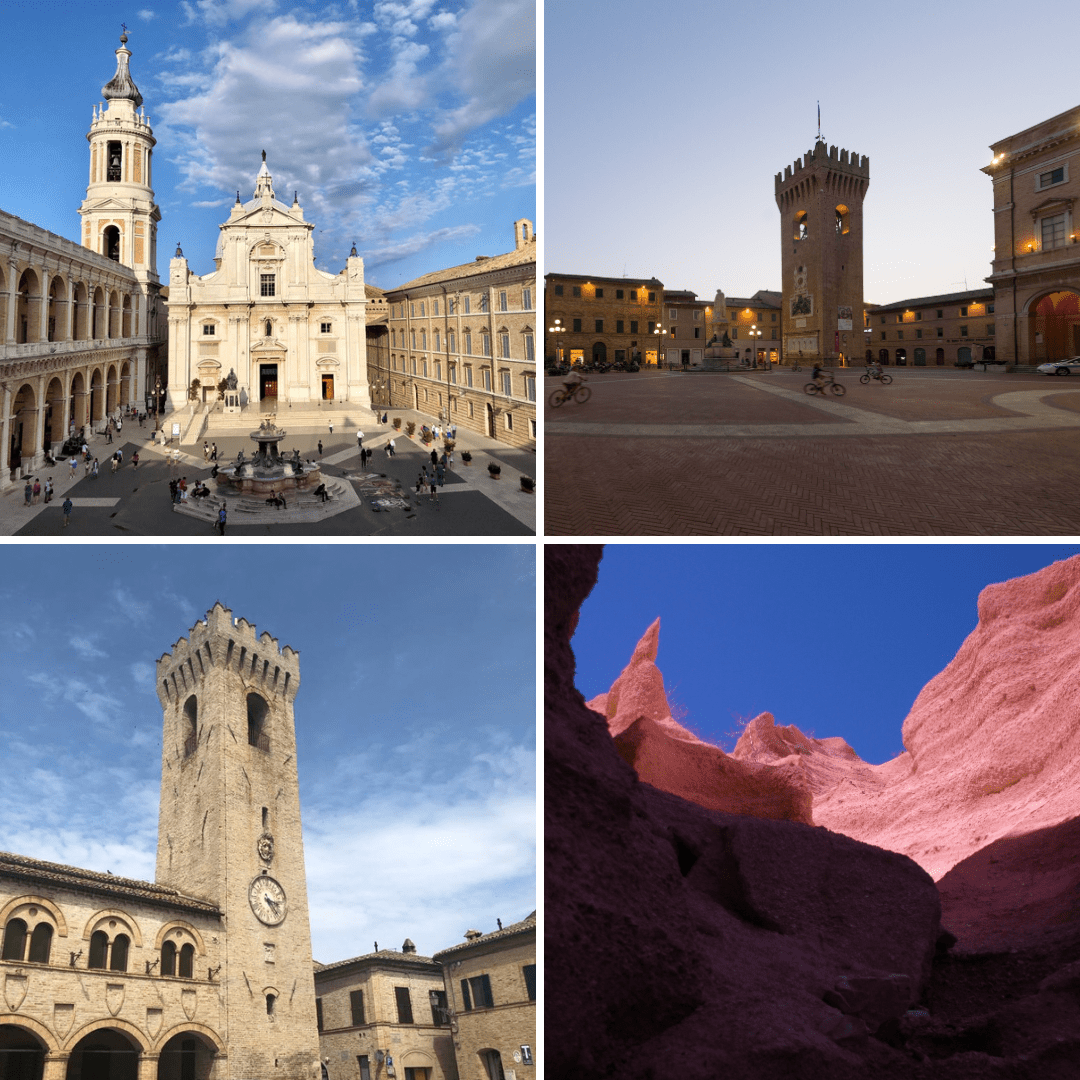
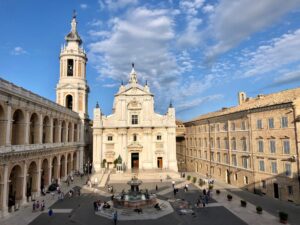
Our Lady Square where the Basilica of the Holy House of Loreto is located

Recanati

In the early afternoon we move a few kilometers toward Recanati, “balcony city” nestled between the coast and the hinterland, which gave birth to famous artists such as the poet G. Leopardi and the tenor B. Gigli and from which many fellow countrymen left in the late 1800s and second half of the 1900s (particularly from its inland districts).

Here the cultural stops are inevitably different (Garden on the Hill of the Infinite FAI, with a guided tour “inside” the poem “L’Infinito,” Piazza and Casa Leopardi, Civic Tower, B.Gigli Museum, Persiani Theater), but the main stop will be at Villa Colloredo Mels, home of the Civic Museums with the Municipal Picture Gallery, whose Renaissance section groups four of the most significant works by Lorenzo Lotto, and the MEMA – Museo dell’Emigrazione Marchigiana: here a special journey awaits us, intended to reknit those deep ties that still unite the Marche region with emigrant communities around the world.

An exciting and interactive experience is proposed thanks to multimedia resources such as a train with carriages telling stories of Marche people who left their region for Argentina, Belgium, and the U.S.; photographs, diaries, and memoirs donated to the Museum; touching tales that can be heard from the third-class cabin of an ocean liner; and searching for travel records of relatives and friends in a database containing more than 5 million names.

After the tour of the Museum is over, we will meet a team from Campus Infinito / D.Alighieri School of Languages who will entertain us with a nice mini course of Marche dialect and recitation of some famous poems.

This is followed by dinner in the tavern with typical dishes such as “piccicasanti,” a kind of sticky soup, and main courses prepared with farm animals, the by-products of pork processing, and local extra virgin olive oil.

Overnight stay in an affordable and sustainable downtown hotel.


Torre del Borgo and Piazza Giacomo Leopardi in Recanati

Montelupone

You will get to know a delightful medieval village in the Marche region, in the province of Macerata: museums, churches, breathtaking views, parks, historic buildings, art and nature. Montelupone is one of the most beautiful villages in Italy, orange flag and still retains its atmosphere of the past, full of beauty and experiences to do.

After a brief look at the Historic Theater, the visit continues, accompanied by our guides and “special” locals at the Anthropological Demo Museum of the Arts of Ancient Crafts, in the basement of the Municipal Palace, to be catapulted into the rural world of yesteryear and the old craft workshops (blacksmith, carpenter, shoemaker…): film machines, sewing machines, agricultural tools, ancient loom for wool processing, even the printing press of the 1800s and a reconstruction of a school. Also, wine cycle equipment, old photos and prints, proverbs, folk songs and nursery rhymes in Montelupone dialect. We will not be missed!

In fact, Montelupone is home to a Roots Workshop built with the city government and local artists, to be followed by a tasting of the great star of local cuisine, the Montelupone artichoke, served with extra virgin olive oil, wine and sourdough bread.
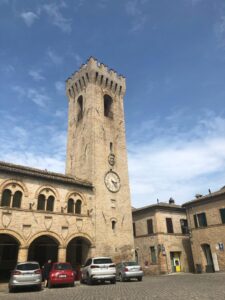
 

Palace of the Podesta and Civic Tower with clock of Montelupone

Macerata

For lunch we travel to Macerata, capital of the province of the same name and home to one of the oldest universities in the world, founded in 1290.

Here, after a rejuvenating meal of short chain and seasonal products, we visit the most iconic places here, where tourism rhymes with beauty!

Monuments and museums are a joy (the Carriage Museum is a must-see), churches a continual discovery (the Cathedral is not to be missed), and aristocratic palaces a plunge into history.

We will glide through the piagge (wide stairways originally used for horses), between Freedom Square and Mazzini Square, the two epicenters of the city.

We greet Macerata with a visit to the Sferisterio, a neoclassical stadium in the shape of an arch, transformed into a temple of opera, which each year hosts a season of outstanding performances, offered in the events section.

Optional visits and excursions: a few kilometers away you can find large expanses of vineyards where the renowned Vernaccia di Serrapetrona, a sparkling wine in dry and sweet types, is grown and produced.

Tolentino

The next stop is Tolentino, where the focus will not be on its cultural heritage , which is just as vast, but more on its manufacturing heritage, discovering some world-recognized brands and one of the region’s industrial hubs of excellence.

After a coffee offered by a leading manufacturer of professional and highly innovative coffee machines, and a short tour of their production facilities, we move to the Poltrona Frau Museum, to learn about the collective historical memory of high-end furniture and leather goods design, timeless Italian craftsmanship and business culture, based on Heritage and Sustainability
 

Abbey of Fiastra, Urbisaglia

Our proposal is to move then to Urbisaglia for a final day of relaxation and open air, where for dinner, overnight stay and sweet awakening, the beautiful Abbey of Fiastra nature reserve: a protected natural area located in the heart of both the Marche region and the mid-hills of the province of Macerata, where one can touch the bonds that have always held man and the environment together, encountering numerous plant and animal species. A nature reserve that is also of special value from a historical and architectural point of view.

Abbey of Fiastra Nature Reserve

Lunch at a farmhouse, same center for overnight stay

Within a few kilometers of Fiastra Abbey, there are several notable stops to consider: Montappone, for example, a small town with a medieval nucleus, recognized worldwide for the production of the straw hat, a typical regional craft tradition (a workshop dedicated to this art is planned to learn about techniques and versions in detail); or, pushing further toward the Sibillini Mountains one encounters San Ginesio, Orange Flag and one of the most beautiful villages in Italy that we definitely recommend not to miss!


Fiastra Lake and Red Blades

It’s time to learn about the Red Blades of Fiastra, another item you’ll be proud of, as a “Marchigiano fuori patria”

If you come from the U.S. or at any rate from overseas, you will find similarities with the great North American canyons, albeit scaled down and surrounded by decidedly different contexts from those to which you will be accustomed, while if you are a European traveler you will be amazed to have such unique landscape features “close by”: pinnacle-shaped rock stratifications and towers consisting of gravel held together by clay and silts, formed through weathering erosion. Located above Lake Fiastra in the province of Macerata, the Fiastrone River, which originates from the lake of the same name, flows beneath them.

The route, round trip on the same trail, is 7 kilometers long, with an elevation gain is 200 meters and a walking time of about 3 hours, so suitable for most people.

The area is particularly striking and varied between long stretches of lush vegetation, short glimpses of the lake to a fairy tale landscape because of the typical red color of the Blades. Return, dinner and overnight stay in facility/agri-tourism


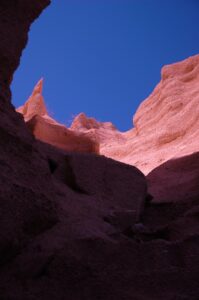
Red Blades, pinnacles and towers of red-colored gravel and clay

start now

Let us guide you on your journey to the Roots

Don't miss the opportunity to explore the places that have shaped your origins, request a tailor-made itinerary without obligation